
Reviewed · KITESURFING & SURFING
Kitesurf Lessons in Cape Verde
Cape Verde’s trade winds have made Sal a major kitesurfing destination, and this two-hour lesson gives you a sensible first taste without asking you to commit to a full course. You begin with a small kite on the beach, then work toward handling a larger kite and moving through the water. I like the step-by-step progression and the fact that you use the real beach where the sport is famous.
I also like the private format: only your group takes part, so the instructor can adjust the pace rather than rush everyone through the same routine. The main drawback is time. Two hours is enough for an introduction, but not enough to guarantee that you will stand on a board or ride independently.
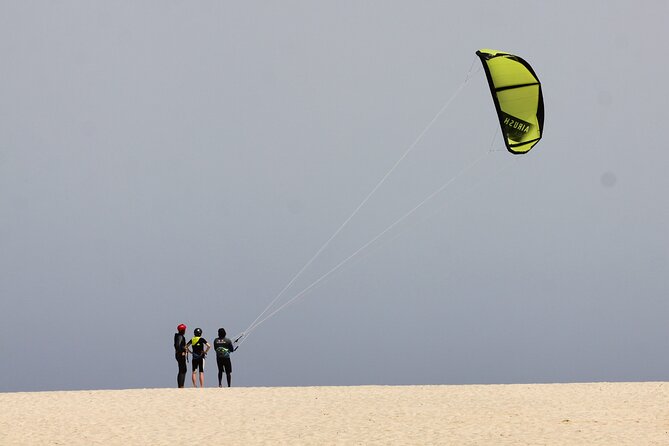
- Small kite first: Build basic kite-flying skills on land before handling larger equipment.
- Kitebeach setting: The lesson takes place at one of Sal’s key kitesurfing spots.
- Safety before water work: You learn the full-size kite’s safety systems before entering the sea.
- Body dragging practice: Your first water session focuses on controlling the kite while being pulled through the water.
- IKO-qualified instruction: The school uses instructors registered with the International Kiteboarding Organization.
- Private activity: Your booking is limited to your own group, rather than a mixed public class.
Starting at Surf Hub Cabo Verde in Santa Maria
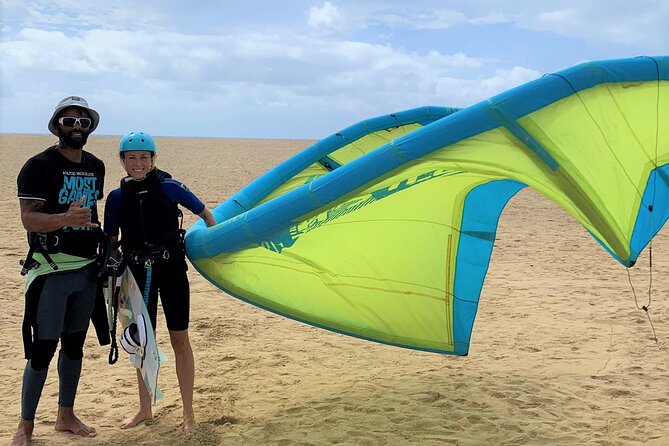
Your lesson begins at Surf Hub Cabo Verde on Rua 15 de Agosto in Santa Maria. This is more than a beach meet-up. It is the point where the school prepares the equipment and gets the session organized before taking you onward to Kitebeach.
That arrangement matters because kitesurfing requires more preparation than simply picking up a board. You need the correct kite, control bar, lines, and safety equipment ready before you reach the sand. Starting at the shop gives the instructor a chance to sort the gear and make sure your group is ready for the lesson.
The listed operating hours are Monday through Saturday, 9:00 a.m. to 4:30 p.m. The activity returns to the same meeting point at the end. The exact timing of the beach transfer is not given, so allow some flexibility around the two-hour estimate rather than planning another tight appointment immediately afterward.
The school has also arranged lifts to Kitebeach for some customers booking lessons and other activities. The supplied details confirm that the class begins at the Surf Hub shop and then moves to the beach, but they do not promise a separate hotel pickup. Plan to reach the shop yourself unless your booking confirmation says otherwise.
Learning with an IKO-qualified instructor
Surf Hub Cabo Verde is an IKO-registered school, and its instructors are IKO qualified. That is useful for a beginner because kitesurfing has real equipment and weather risks, and a recognized teaching structure gives the first lesson a clear order.
The instruction is not just a quick attempt to launch a kite. You first learn the basic skills of kiteflying with a small training kite. This lets you feel how the kite responds to the control bar and how changes in direction affect its pull, without immediately dealing with the power of a larger kite.
You then move to the full-size kite. Here, the focus includes both kite control and the safety systems. That second part deserves your full attention. The sport is powered by wind, so knowing how to reduce power and respond to a problem is just as important as steering well.
The school’s instructors have been described as patient, professional, and good at keeping the instruction fun while maintaining safety. One instructor named in the school’s wider teaching feedback is Tchu. Amy is also closely associated with organizing lessons, transfers, accommodation, and other activities through Surf Hub Cabo Verde. The booking information does not guarantee that either Amy or Tchu will teach your specific session, so treat those names as useful context rather than a promised instructor assignment.
More kite and surf lessons on Sal:
- Surf Lessons
★ 5.0 · 60 reviews - Sal: Surf Lesson
★ 4.7 · 48 reviews - Kite Surf Lessons on Sal Island
★ 5.0 · 17 reviews
The small-kite lesson on the beach

The beach section is where you get your first real feel for kitesurfing. You work with a small training kite and practice the basic actions needed to keep it flying in a controlled way.
This may look simple from a distance, but it is the part that gives the rest of the lesson structure. You learn how the kite sits in the wind window, how the bar affects movement, and how to keep your attention on the kite while following the instructor’s directions. You also start building the hand coordination needed later in the water.
I like this format because it avoids throwing a complete beginner straight into the sea with a powerful kite. You get time to understand the equipment while standing on firm ground. The drawback is that the first part can feel less thrilling than people expect. If you arrive hoping to ride a board right away, this opening may seem slow, but it is necessary groundwork.
The exact length of the beach practice is not specified. It depends on your group, the wind, and how quickly you become comfortable with the controls. A private class helps here because the instructor can spend more time on the parts you find difficult.
Moving to the full-size kite
After the training kite, you progress to a larger kite and learn its safety systems. This is the point where the sport begins to feel more powerful and physical.
You will need moderate physical fitness for the activity. Handling a kite means responding to wind force, keeping your balance, and following instructions while managing equipment. The school also requires you to be able to swim, which is essential once the lesson moves into the water.
Do not think of the full-size kite section as a test that you either pass or fail. The useful goal is to understand how to control the kite and how to release or manage its power safely. The instructors’ job is to keep the first lesson within a reasonable level for a beginner.
Because the experience lasts about two hours, you should view this as a foundation lesson rather than a complete kitesurfing course. Some people may progress quickly and reach the water with confidence. Others may spend most of the session practicing kite control on land. Both outcomes can be worthwhile, since safe control is the skill that supports everything else.
Body dragging at Kitebeach
The final stage takes you into the water with the instructor for body dragging. This means using the kite’s pull to move through the water without yet riding a board. It is a key bridge between beach practice and actual board work.
Body dragging teaches you how the kite affects your body once you are no longer standing on the sand. You begin to feel the pull of the wind and learn how to move through the water while keeping control of the kite. It also gives you a practical introduction to what happens if you become separated from your board during a later lesson.
Kitebeach adds a strong sense of place. Sal is known for kitesurfing, and this is the location where the sport’s local reputation becomes more than a brochure claim. You are practicing in the island’s main kitesurfing setting, with the wind and open water that draw people here for the sport.
Still, body dragging is not the same as riding. The supplied description does not promise that you will stand on a board, make a first run, go upwind, or complete transitions during this two-hour session. If you want those milestones, you should ask Surf Hub Cabo Verde about booking follow-up lessons.
A few more Sal trips worth comparing
- Sal Island: Catxupa Cooking Class with a local family
★ 4.7 · 72 reviews - Sal: Kizomba Group Class – Santa Maria, Cape Verde
★ 4.5 · 28 reviews - Sal: Kitesurfing Lessons
★ 4.0 · 7 reviews - From Praia: Banana Plantation Tour and Cuscuz Workshop
★ 4.8 · 75 reviews
What makes the private format valuable
This is a private activity, so only your group participates. That is one of its strongest features, especially if your group includes people with different levels of experience.
A complete beginner may need extra time with the bar, the safety release, or the first water exercise. Someone who has taken lessons before may move more quickly. In a private setting, the instructor can respond to those differences instead of following a fixed public-class rhythm.
The format also suits families and small groups. The school has worked with groups that included complete beginners, a person with some previous lessons, and an experienced kitesurfer. That range suggests the teaching can accommodate mixed ability, although the booking data does not state how many people may be in one private group.
Private does not mean the session will be leisurely from start to finish. You still have only about two hours, and every part of the lesson has a job. Arrive ready to listen, ask questions when something is unclear, and accept that wind conditions may affect how much time you spend in each stage.
Is $141.14 a fair price?
The price is $141.14 per person. For a two-hour first lesson, that is not a casual beach activity price. The value depends on what you want from the session.
You are paying for qualified instruction, equipment preparation, beach-based training, safety instruction, water practice, and a private booking rather than a standard mixed class. If you are curious about kitesurfing but do not want to buy gear or sign up for a longer camp, this is a practical way to test the sport.
The price makes less sense if you expect a full course or guaranteed independent riding. Two hours is simply too short for that promise. I would treat the booking as an introductory session that helps you decide whether to continue, not as a complete result-based lesson.
Surf Hub Cabo Verde also offers wider packages that can include accommodation, transfers, island trips, sailing, yoga, surfing, and kitesurfing. Those extras are not part of this activity’s stated price, so check carefully if you are comparing this lesson with a multi-day package.
Who should book this Sal lesson?
This experience is best for you if you want to try kitesurfing in the sport’s natural setting and prefer a focused introduction. It suits a first-timer who is willing to learn the basics before expecting board time.
It can also work for someone with a little past experience who wants a private refresher. The instructors have taught people progressing toward upwind riding and transitions, but this particular booking only promises the introduction, safety work, and body dragging stage.
I would be cautious about booking it for anyone who cannot swim or who has less than moderate physical fitness. Those are stated requirements, not minor suggestions. You should also remember that the activity depends on good weather. If poor conditions cancel the lesson, you can choose another date or receive a full refund.
The session runs Monday through Saturday, and the listed operating periods extend through July 24, 2026. Confirmation is provided at booking, and mobile tickets are supported. Service animals are allowed.
Cancellation and planning advice
You can cancel up to 24 hours before the start time for a full refund. Changes or cancellations made less than 24 hours before the activity are not accepted for a refund, and the cut-off follows local time in Cape Verde.
Give yourself enough time to reach Surf Hub Cabo Verde in Santa Maria. Since the shop is the starting point and the class then continues at Kitebeach, arriving late could cut into the lesson’s short beach and water sections.
Wear what you can move in and be ready for a physical activity, but the supplied information does not specify a required clothing list. The school prepares the equipment for the lesson. If you have a medical concern, contact the provider before booking, since the session involves wind force, water work, and moderate physical effort.
Should you book it?
Book this lesson if you want a well-structured first look at kitesurfing and value private instruction over a quick group demonstration. The progression from a small kite to a full-size kite, safety systems, and body dragging makes sense, and the IKO-qualified teaching gives the session a solid framework.
Skip it if you want guaranteed board riding in a single visit or if you cannot swim. At $141.14, it is a serious introductory purchase, but it can be good value for someone who wants to test the sport without committing to a longer course. Ask about follow-up lessons if your real goal is to ride independently, go upwind, or learn transitions.
FAQ
Where does the kitesurf lesson begin?
The lesson begins at Surf Hub Cabo Verde on Rua 15 de Agosto in Santa Maria, Sal, Cape Verde.
Where does the activity finish?
The activity ends back at the Surf Hub Cabo Verde meeting point.
How long does the kitesurf lesson last?
The lesson lasts approximately two hours.
Do I need to know how to swim?
Yes. Participants must be able to swim.
What level of fitness is required?
You should have a moderate level of physical fitness.
Is the lesson private?
Yes. Only your group participates in this activity.
What happens if the weather is poor?
If poor weather causes the activity to be canceled, you will be offered another date or a full refund.
Newly listed around Sal
- Watch Sea Turtles Nesting – Night Tour in Sal Island★ 4.1 · 14 reviews
- 3-Hour Shark Bay and Salt Lakes in Sal Island Guided Tour★ 4.5 · 19 reviews
- Turtle Experience in Sal island★ 4.0 · 5 reviews
- Secrets of Sal Island 4×4 Tour with Pedra da Lume Salt Lake★ 4.5 · 6 reviews
- Sal island: Private Santa Maria City Tour, Street Art and Tapas★ 5.0 · 6 reviews
- Sal Island: 3-Hour Private Tour with Floating in Salt lake & Shark Watching★ 5.0 · 8 reviews
- Small Group Full Day Island Tour in Sal★ 4.0 · 12 reviews
- Sal island: Espargos city tour, Local life and Cape Verde Tapas★ 4.5 · 22 reviews
Kitesurfing & Surfing, compared.
Browse the lists this tour appears in